Clergy Speaking on the Present War
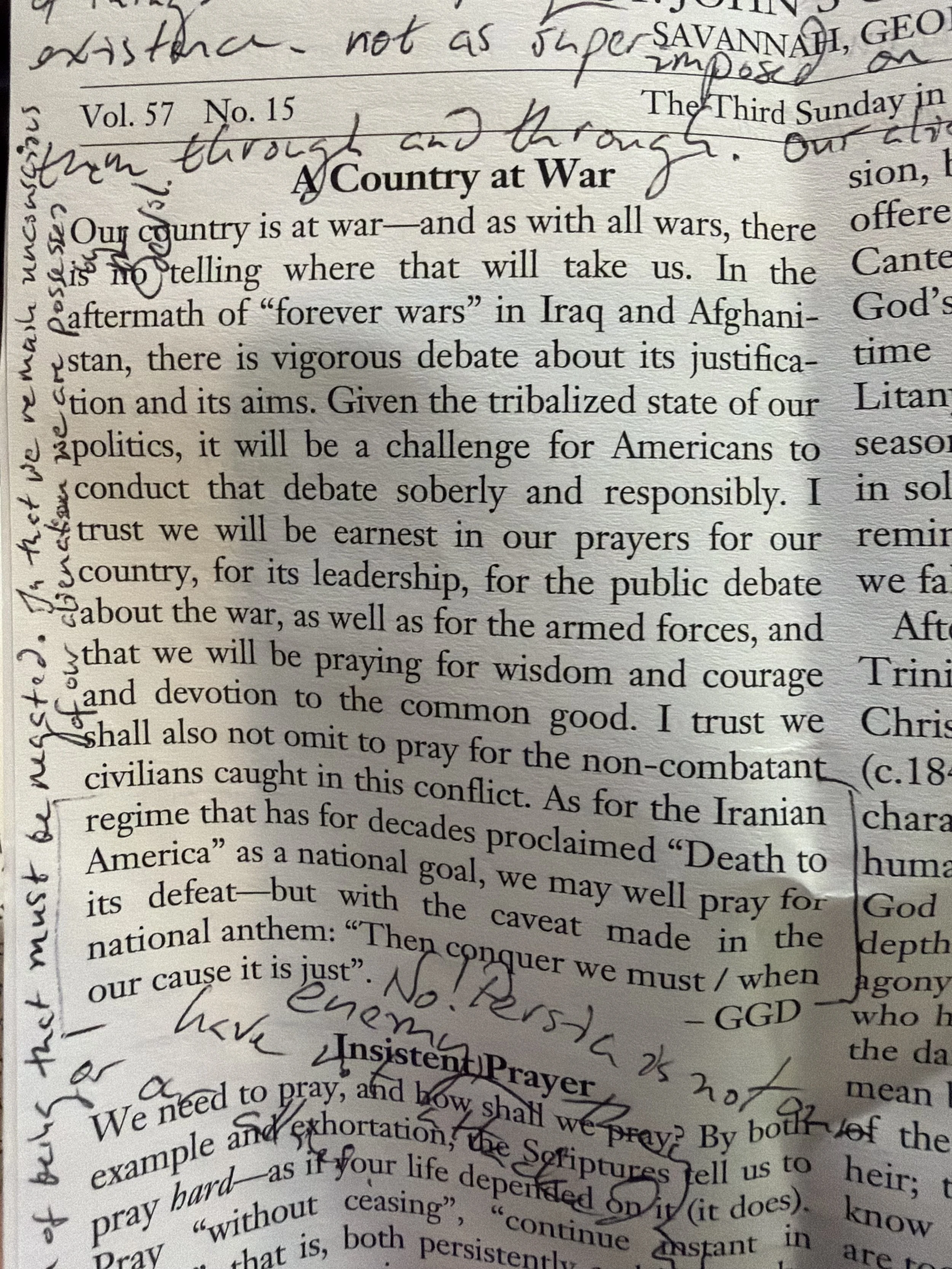
Pictured here is a notice in a church service leaflet, published the Sunday following the beginning of the US-Israeli war against Iran. While on the face of it, the notice is simply a call to prayer in time of war, it communicates much more than that. The cool, apparently evenhanded objectivity hides false equivalency, selective evidence, and loaded terminology. This notice illustrates how US clergy, ministering in the imperial core, unwittingly manufacture consent for unjust imperial military aggression.
It opens with apparent neutrality, leaving open the question of whether the US attacks on Iran on 28 Feb., the launching of Operation Epic Fury, initiating the war in which several nations are now embroiled, was justifiable. However evenhanded that may seem, it is deeply misleading. This isn’t an open question. Suggesting that it is so is pseudo-objectivity and pseudo-neutrality. The fact of the matter is that this act of military aggression violates the moral justification for the use of military force — national defense — and international law, under Article 2 of the UN Charter.
The various and contradictory rationales for initiating this war put forward by the White House and the Knesset do not demonstrate a just basis for launching Operation Epic Fury. On March 17, 2026, Joseph Kent, resigned as Director of the National Counterterrorism Center, over the unjustified military aggression against a nation that posed no direct threat to the US.
The notice, obscuring the demonstrable fact of the matter, calls on church members to debate whether this war is just ‘soberly and responsibly’ as if it is in question, giving the false appearance of fairness. To treat two options as if they are equally probable when they are not is a false equivalency. And, while this might seem relatively harmless at first glance, it is not as if the hostilities cease for a post-hoc debate. Far from it! The air strikes on Iran continue unabated. This is a mystification that gives the false impression that there is an equally legitimate case to be made on either side of the matter, which we ought to calmly debate while we continue to bomb Iran. This kind of both-sides-ism — which is, I'm sorry to say, too often a reflex of US clergy, wishing not to upset their parishioners — only works to the benefit of the aggressor. It is not neutral.
The notice reminds readers of the Iranian cry ‘death to America’. It is a fact, to be sure, so to include it is simply to look at the situation dispassionately, right? No, a decontextualized fact is as misleading as a lie. The selection of facts of which to remind readers, if it is not representative of the totality of the situation, stacks the deck or tilts the playing field in a particular direction. And, in this case, the selective evidence tilts things in precisely the same direction as the false equivalency already discussed. While stating that we should openly debate whether the war is justified, suggesting there’s an equally reasonable case on either side — when, in fact, there isn’t — this cherry-picked evidence emotionally justifies the war, which, once again, benefits the aggressor.
The context for Iran’s hatred of the US government is one of unremitting US hostility going back to at least 1953, when the US-UK coup d'état, Operation Ajax, resulted in the overthrow of the democratic government of Iran and plundered its publicly owned oil company. The elected Prime Minister Mohammad Mosaddegh was removed and a brutal autocrat, Shah Mohammad Reza Pahlavi, who sold off the oil industry to Western private corporations.
Following the 1979 revolution, the US has pursued a policy of continuous economic warfare. The US has imposed severe economic sanctions, frozen Iranian assets, and severed diplomatic ties. The US then engaged in a proxy war against Iran after the CIA facilitated Saddam Hussein’s takeover of Iraq. With the blessing of the US, Hussein’s war against Iran included the worst chemical weapons use in history. Following that, the US fought an undeclared naval war in the Persian Gulf in 1987-1988, including the 1988 destruction of an Iranian passenger plane by the USS Vincennes, killing 290 civilians. The Clinton administration imposed an oil and trade embargo on business with Iran by American companies. After the September 11 attacks, President Bush called Iran part of the ‘Axis of Evil’, including Iraq and North Korea, despite none of these nations having anything whatever to do with the attack. Bush applied pressure on Iran via covert operations. In 2020, the US assassinated Iranian General Qasem Soleimani in Baghdad. President Trump imposed further sanctions on Iran, a policy dubbed the “maximum pressure campaign." And, of course, there is also the unprovoked Israeli attack in June, initiating the 12-day war, in which the US joined. Before the present war began, the US had between 40,000 and 50,000 troops stationed around Iran in at least 19 sites.
This is not to say that Iran has not engaged in any hostility towards the US, but none of Iran’s hostility has been unprovoked. Indeed, the US has kept Iran on the defensive. To say that Iranians cry ‘death to America’ without mentioning any of this context is deeply misleading. Moreover, lest we slip back into false equivalencies, we must not forget that the US is a global superpower — Iran is not. Iran is a regional power that has been under economic siege enforced by the US since 1979, surrounded by US military bases in the Gulf Arab Kingdoms, and subject to occasional unprovoked military hostility either directly from he US or via US-backed proxies. This is an asymmetrical war. Iran spends less than 1% per year on its military of what the US spends on its military.
The Iranian government has stated that it harbors no hostility to the people of the US, only its government, US government officials, by contrast, have made no such distinction. Senator Linsey Graham has said ‘We’re going to blow the hell out of these people’. Secretary of War Pete Hegseth has said, ‘Iranians will be met with death and destruction all day long’ and ‘The only ones who need to be worried are Iranians who think they’re going to live… the US plans to win through sheer destruction’. President Trump has said ‘We’re now targeting all areas and people in Iran for complete destruction and certain death.” Despite this, Abbas Araghchi, Minister of Foreign Affairs of Iran, says Tehran ‘does not want to harm ordinary Americans’.
Bidding us pray for civilians ‘caught in the conflict’ makes it sound as if the US and Israel are not intentionally targeting civilian sites. But they are, in flagrant violation of the Geneva Convention. The US is carpet bombing Tehran, a city of 10 million people. No US city has ever experienced anything like this — it’s truly unimaginable and unconscionable. The sky over Tehran turned black with smoke as acidic rain fell from the sky, due to strikes on Iranian fuel storage and oil depots. The full consequences, the harm inflicted by bombing these sites, will unfold over many years, with substantially increased cancer rates and other chronic illnesses. This is chemical warfare, make no mistake. An elementary school in Minab was bombed twice, forty minutes apart, killing 168 children and 14 teachers. This sort of double-strike strategy is designed to take out the rescue teams, giving just enough time for them to arrive on site before dropping the second bomb. Civilians aren’t getting “caught in the conflict” — they’re being targeted. Nor should that be a surprise when the US Secretary of War has publicly rejected any ‘stupid rules of engagement’ (as he put it).
‘Caught in the conflict’ is loaded language. The wording suggests its civilian casualties are accidental, an assumption not supported by the evidence, either of the sites that have been hit or statements from the White House. Used by clergy in a church service leaflet, it is white washing while draped in brocade vestments and swinging a thurible fragrant incense. But no amount of incense can cover the stench of injustice.
There are other instances of loaded language in the notice as well. Saying ‘Iranian regime’ rather than ‘government’ delegitimates the government. One need not like or approve of the Iranian government, but referring to it as a regime in this context can only do one thing: make an illegal war of aggression feel justified. Again, it is a mystification — it hinders clear perception.
Finally, it is noteworthy what the notice does and does not bid the congregation pray for. Rather than bidding prayers for peace, for a cessation of hostilities, for the repentance of US leaders who are prosecuting an unjust war at the cost of thousands of lives, the minister bids prayers for the ‘defeat’ of Iran. Let us be clear what that means: the destruction of Iran, the devastation of its people, infrastructure, and government. One need only look at Libya following the NATO-backed overthrow of its government to see what the results of such a victory would mean. There are legitimate humanitarian concerns about Iranian authoritarianism, to be sure. That is true of US ally Saudi Arabia, too, it is worth remembering. Those legitimate humanitarian concerns do not justify attacking Iran. Those who have such concerns must also recognize what the defeat of the Iranian government would mean from a humanitarian point of view. The instability and devastation that would follow such a defeat would mean a far, far worse situation for the people of Iran, especially for the most vulnerable. Where instability prevails, so too does violence. Defeat for the US, by contrast, would mean a military withdrawal from the Persian Gulf, a shifting of the geopolitical balance of power. It would not mean the devastation of the people of the US, a majority of whom oppose this war.
For Iran, defense is an existential necessity. It is justified morally and their right under the UN Charter. For the US, this war is an unforced choice, an act of overt aggression, illegal under international law, and morally reprehensible. Iran has not attacked the US; the inverse is the case. Iran is not the enemy of the American people, but the US government has targeted Iranian civilians, and the White House has not been shy in saying it aims at the total destruction of Iran, not simply eliminating its military capabilities. One would not know that, however, from reading this call to prayer in this church service leaflet. It misleads its parishioners. What at first glance might appear as simply a call to pray during a time of war is (whatever its intentions) effectively manufacturing consent for a war of aggression. Rather than prophetically calling out the unjust use of power, it hides the injustice and comforts the powerful, regardless of whether or not that was the intention of its author.
I am not singling out the cleric who wrote this notice. I’ve seen its like many times from many US clergy. That’s why I’m drawing attention to it — not because it’s uniquely objectionable, nor that the parish in the care of this pastor is so very large. This is a representative sample of a general tendency towards both-sides-ism and whitewashing that has the effect of making an empire look not so imperial, of making capitalism and colonialism look not quite so cruel. It is often not intentional at all. It is usually rooted, I think, in the comfort of ministering in the imperial core and the reluctance to offend unnecessarily. It is understandable. But it is not okay. The clergy have a responsibility to the vulnerable, the weak, the poor, the alien, and the powerless. And, because these are not stable, static conditions, but rather caused by forces that continue to apply pressure, to say nothing against those forces of injustice is not to simply leave things as they are, but rather to quietly watch them get worse.
It may be that the minister, writing from the comfort and security of a parish in the imperial core, is simply unaware of the context I’ve described here. But, if so, it’s a willful ignorance. This information was not hard to come by. And, regardless, clergy do not get a free pass to be ignorant of such matters, because they have a pulpit, a public platform, a position of moral authority. The privilege of a pulpit is a burden; the vestments are heavy. If the clergy do not wish to be simply the chaplains of empire, absolving its acquisitiveness, quieting its conscience so that it can proceed unhindered, then US clergy must ‘stand in the gap’ as Ezekiel says (Ezekiel 22:30). They must always scrupulously interrogate the rhetoric and actions of the powerful, hold them to account, and demand that those with wealth and with power over others do justly, love mercy, and walk humbly (Micah 6:8). If they aren’t sure what to exhort their congregations to pray for, as surely sometimes they won’t be, they should bid prayers of repentance not prayers that authorize aggression.